Launch offer — valid today only

The Easiest Way to Prepare for the Part 107 Remote Pilot Test With Every Rule Drawn Step by Step!

Sectional charts, Class B, C, D and E airspace, METARs, TAFs, density altitude, Remote ID, operations over people and LAANC: in the study guide, it's a wall of text. Here every topic fits on one page, with the drawing and what you need to remember. 63 illustrated pages.

I WANT TO STUDY IT WITH DRAWINGS

🔒 Secure checkout · PDF by email · 30-day guarantee

One topic per pagethe drawing teaches you the rule and the text backs it up
63 illustrated pages9 parts, from drone owner to test day
Up-to-date sources14 CFR Part 107, FAA-G-8082-22 and AC 107-2A

This Is What the Pages You Will Study Look Like

One topic per page, the drawing that shows you how it works and the boxes with what you need to know:

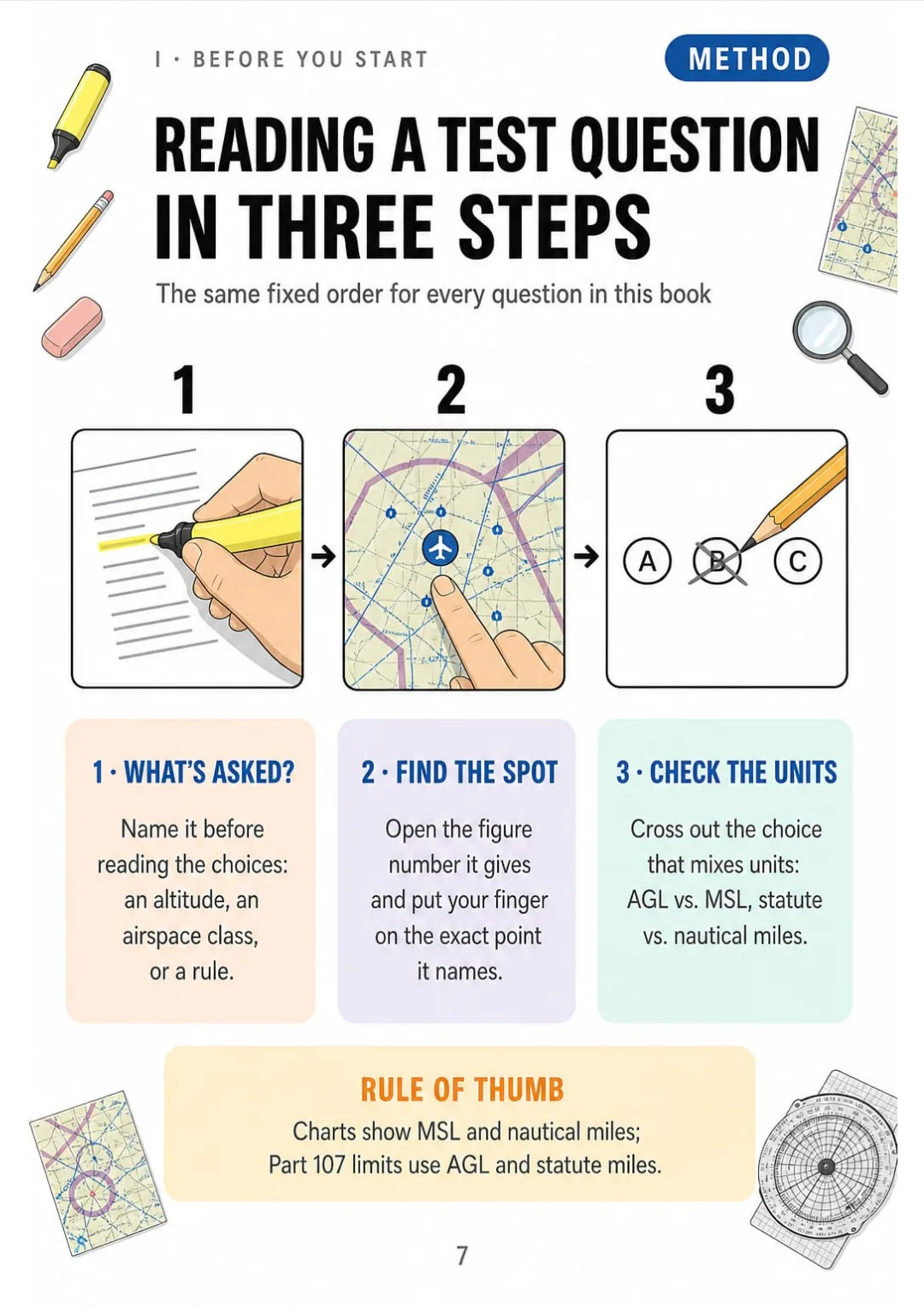
1) What is asked · 2) Exact spot on the figure · 3) Cross out the mixed-units answer.
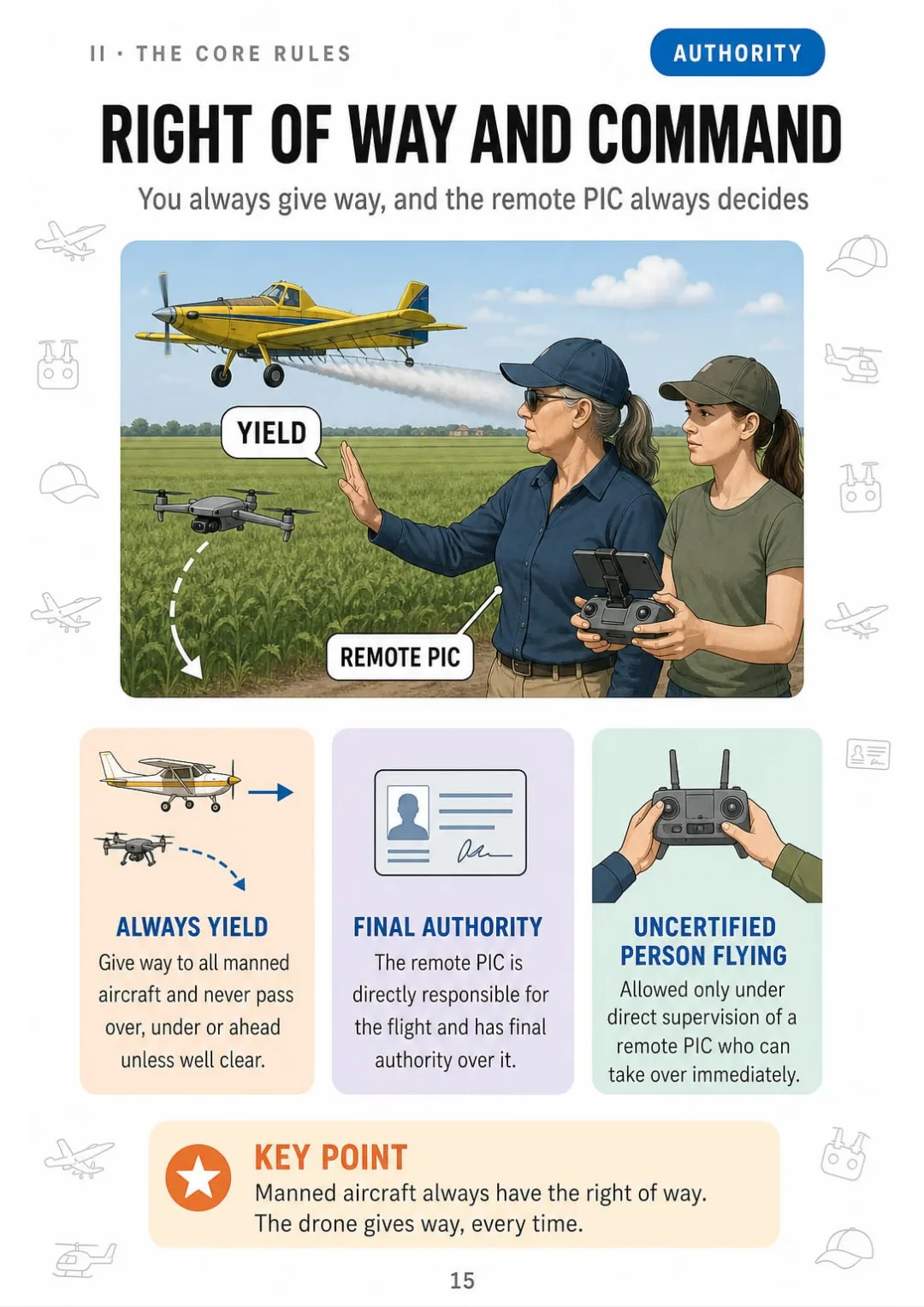
Yield to all manned aircraft · remote PIC has final authority
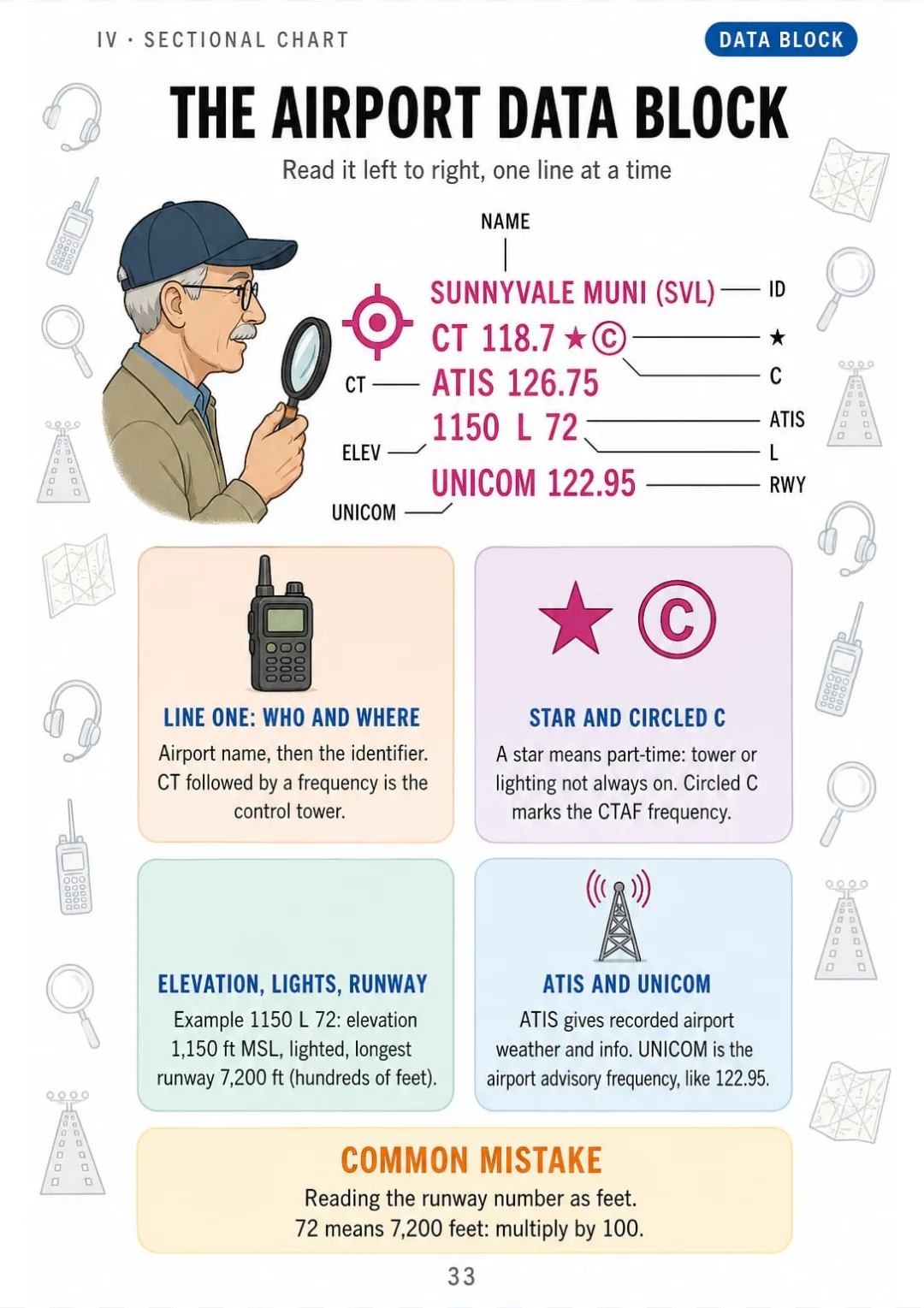
CT = tower, ★ = part-time, circled C = CTAF, 72 = 7,200-ft longest runway.
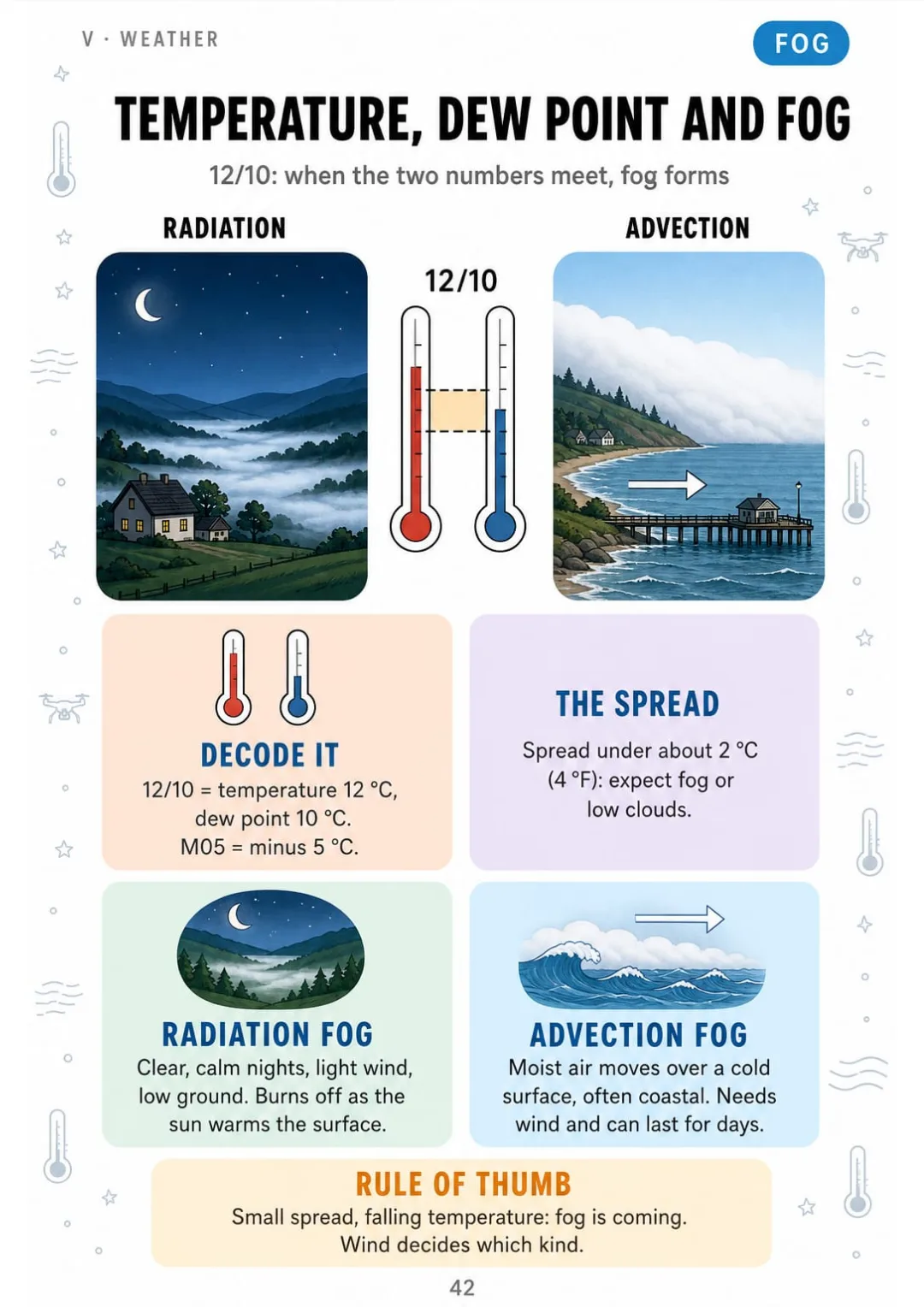
Spread under about 2 °C points to fog; radiation fog vs. advection fog
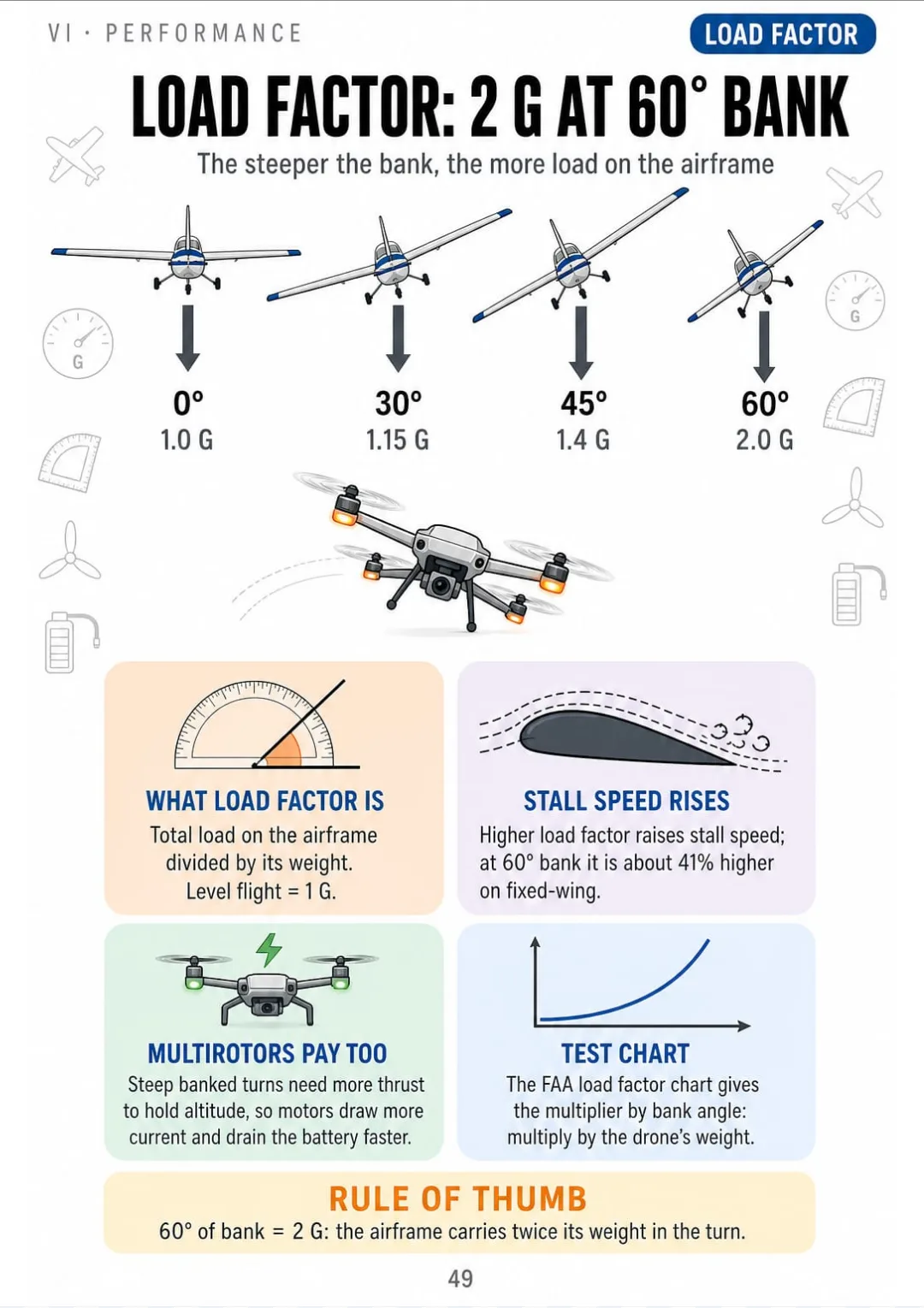
30° ≈ 1.15 G · 45° ≈ 1.4 G · 60° = 2 G: steeper turns, higher stall speed.
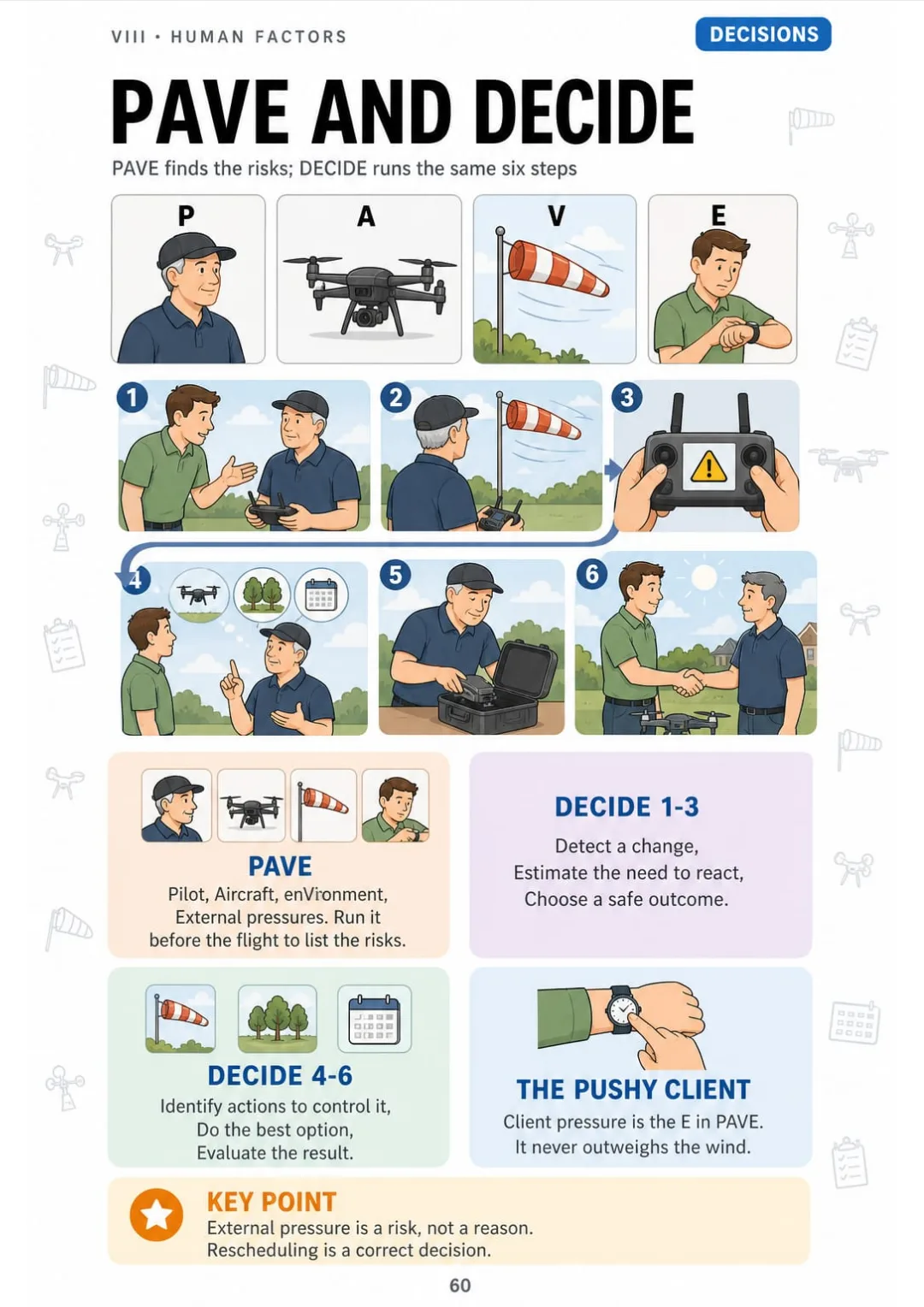
PAVE lists the risks; DECIDE runs Detect, Estimate, Choose, Identify, Do, Evaluate in order.
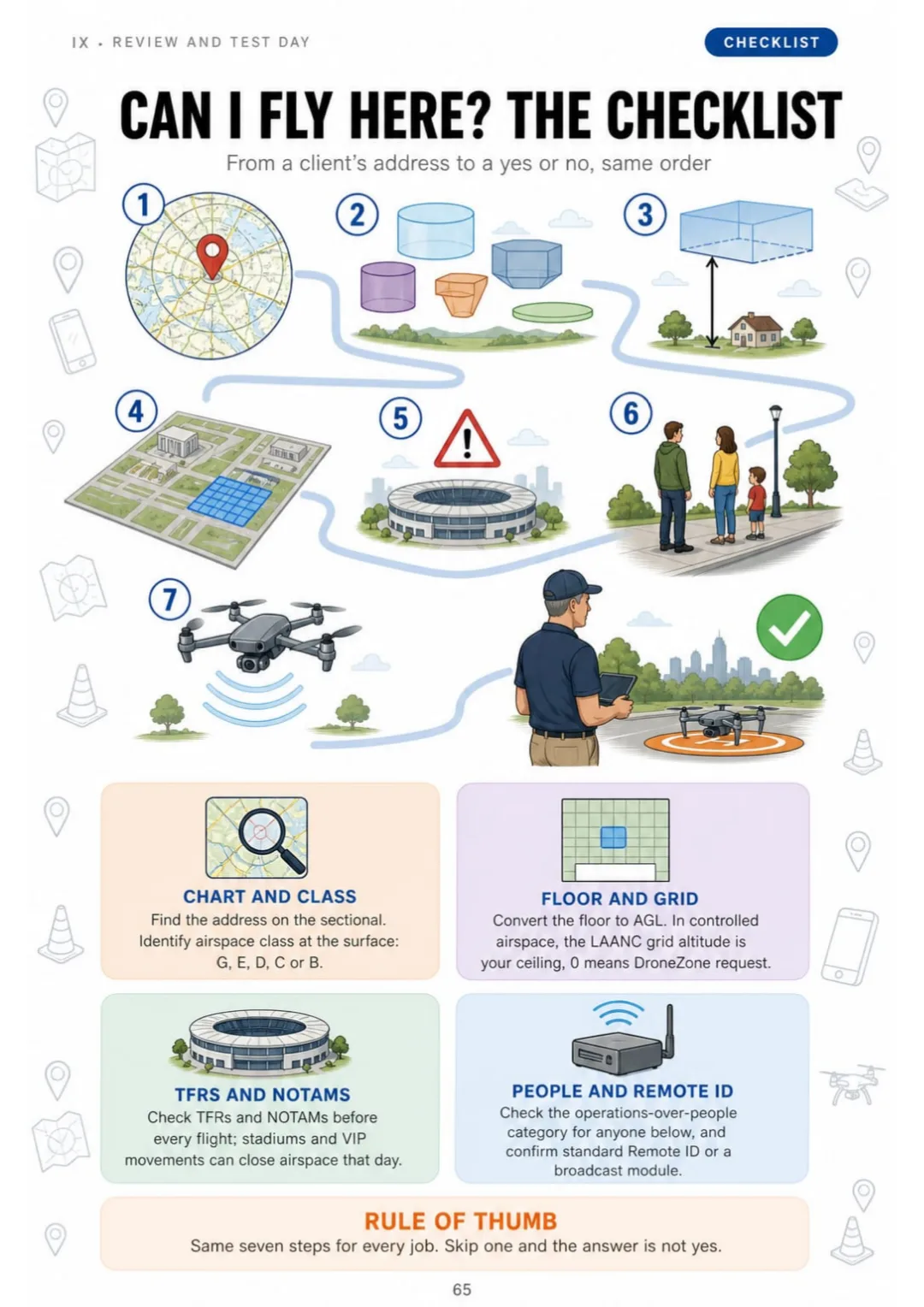
Chart → class → floor in AGL → LAANC grid → TFRs and NOTAMs → people below → Remote ID

Swipe to see more →

These are real pages from the book. The table of contents is the full one: 9 parts and 63 topics.

It's Not That You Don't Have a Memory. It's That No One Put It in Order.

You've read the Class E floor three times. You close the study guide...

...and you can't tell if it starts at 700 or 1,200 feet. It was all just lines in a row.

CT = tower, ★ = part-time, circled C = CTAF, 72 = 7,200-ft longest runway.

Here Class E is a drawn page: the faded magenta edge where the floor drops to 700 feet AGL, the 1,200-foot floor almost everywhere else, and your drone at 400 feet underneath.

And on the pages next to it, every class has its own: Class G, the dashed blue Class D, the solid magenta Class C, the solid blue Class B and the TFRs.

And if you fly for fun and someone asks you to shoot a roof near an airport? Recreational vs. Part 107 on one page. Remote ID, LAANC and the 400-foot ceiling each drawn on their own. And the Can I Fly Here? checklist walks you through it: chart, airspace class, floor in AGL, LAANC grid, TFRs, people below and Remote ID, in the same order every job.

Been flying Part 107 for two years? 400 feet, 3 statute miles, 500 below the clouds. Numbers learned as a loose list fade. Here they're all on one page, with the drawing that keeps them in place.

First you understand why it works that way. Then the order sticks on its own.

SEE THE DIFFERENCE

Stop memorizing rules you can't picture:

THIS
  • Page after page of dense text
  • Airspace rules without a single drawing
  • On the test, you don't know where to start
Class E airspace is controlled airspace that is not designated as Class A, B, C or D. Except where otherwise designated, Class E begins at 1,200 feet above ground level; however, in the vicinity of certain airports it may extend downward to 700 feet AGL, as depicted by a magenta vignette on sectional charts, or to the surface, as indicated by dashed magenta lines. Remote pilots must determine the applicable floor and confirm whether an airspace authorization is required prior to operation.
FOR THIS
  • Every rule drawn
  • One topic per page, with the rules in boxes
  • You remember it because you've seen it
Yield to all manned aircraft · remote PIC has final authority
CONTENTS

Take a Look at the 9 Parts and 63 Topics

Getting started, the core rules, airspace, the sectional chart, weather and the METAR, performance and loading, operations on the job, human factors and test day review: 63 pages, all illustrated

IBefore You Start · pp. 5-9
  1. From Drone Owner to Remote Pilot
  2. What the Knowledge Test Looks Like
  3. Reading a Test Question in Three Steps
  4. Recreational Flyer or Part 107?
  5. Staying Current After You Pass
IIThe Core Rules · pp. 10-19
  1. Registration and Marking
  2. The 400-Foot Ceiling
  3. Speed Limit
  4. Visibility and Cloud Clearance
  5. Visual Line of Sight
  6. Right of Way and Who Is in Charge
  7. Moving Vehicles, Carriage and Hazardous Materials
  8. Alcohol and Drugs
  9. Accident Reporting: The 10-Day Rule
  10. Emergencies, Waivers and Inspections
IIIAirspace in Drawings · pp. 20-28
  1. The Airspace Layer Cake
  2. Class G: Uncontrolled Airspace
  3. Class E: The 700 vs. 1,200-Foot Floor
  4. Class D: The Dashed Blue Cylinder
  5. Class C: The Solid Magenta Wedding Cake
  6. Class B: The Solid Blue Upside-Down Cake
  7. Special Use Airspace
  8. Other Areas: MTRs, TFRs and Stadiums
  9. LAANC and DroneZone Authorizations
IVThe Sectional Chart Step by Step · pp. 29-37
  1. The Fixed Order for Any Chart Question
  2. Latitude and Longitude on the Chart
  3. MSL vs. AGL: The Conversion
  4. Airport Symbols
  5. The Airport Data Block
  6. Obstructions and Towers
  7. The Maximum Elevation Figure
  8. Chart Legend Symbols Worth Knowing
  9. Airport Operations and the Traffic Pattern
VWeather and the METAR · pp. 38-46
  1. Reading a METAR Left to Right
  2. Wind and Gusts
  3. Clouds and the Ceiling
  4. Visibility and Weather Codes
  5. Temperature, Dew Point and Fog
  6. Reading a TAF
  7. Pressure, the Standard Atmosphere and the Altimeter
  8. Stability, Fronts and Air Masses
  9. Thunderstorms and Microbursts
VIPerformance and Loading · pp. 47-50
  1. Density Altitude
  2. Weight, Balance and Center of Gravity
  3. Load Factor in Turns
  4. LiPo Batteries: Care and Fire Risk
VIIOperations on the Job · pp. 51-57
  1. Remote ID: Three Ways to Comply
  2. Operations Over People: The Four Categories
  3. Flying Over Moving Vehicles and Crowds
  4. Night and Twilight Operations
  5. The Preflight Inspection
  6. Crew Roles and Communication
  7. Lost Link, Flyaways and Radio Basics
VIIIHuman Factors and Decisions · pp. 58-62
  1. IMSAFE: Are You Fit to Fly?
  2. The Five Hazardous Attitudes
  3. Aeronautical Decision-Making: PAVE and DECIDE
  4. Physiology and Vision
  5. Crew Resource Management and Maintenance
IXReview and Test Day · pp. 63-67
  1. The Most Frequent Mix-Ups on One Page
  2. All the Numbers on One Page
  3. Can I Fly Here? The Job Request Checklist
  4. Test Day Walkthrough
  5. Where to Check the Current Rules

What If Every Topic Fit on a Single Page?

Imagine this:

Instead of rereading half a page on the airport data block without being able to see it...

...you open the page and find every symbol pointed out on the drawing: CT for the tower, the star for part-time, the circled C for CTAF, and 72 for a 7,200-foot runway.

30° ≈ 1.15 G · 45° ≈ 1.4 G · 60° = 2 G: steeper turns, higher stall speed.

And the METAR, the airspace classes, density altitude, Remote ID and operations over people turn into drawings and tables you can read at a glance.

You stop repeating and start understanding.

That's exactly what Clear to Fly does. It's not "just another study guide." It's 9 parts and 63 drawn topics, and at the end all the numbers on one page and the Can I Fly Here? checklist.

Because what your brain sees organized, it remembers.

Here Is What You Get with Clear to Fly:

Ipp. 5-9

Before You Start

How you go from drone owner to remote pilot, what the knowledge test looks like, reading a question in three steps, recreational vs. Part 107, and staying current after you pass.

IIpp. 10-19

The Core Rules

Registration and marking, the 400-foot ceiling, the speed limit, visibility and cloud clearance, line of sight, right of way, alcohol and drugs, and the 10-day accident rule.

IIIpp. 20-28

Airspace in Drawings

The airspace layer cake, Classes G, E, D, C and B, special use airspace, MTRs, TFRs and stadiums, and LAANC and DroneZone authorizations.

IVpp. 29-37

The Sectional Chart Step by Step

A fixed order for any chart question, latitude and longitude, MSL vs. AGL, airport symbols, the data block, obstructions, the maximum elevation figure and the traffic pattern.

Vpp. 38-46

Weather and the METAR

A METAR left to right, wind and gusts, clouds and the ceiling, visibility, dew point and fog, the TAF, the altimeter, fronts and thunderstorms.

VIpp. 47-50

Performance and Loading

Density altitude, weight and balance, load factor in turns, and LiPo battery care and fire risk.

VIIpp. 51-57

Operations on the Job

Remote ID three ways, the four categories of operations over people, moving vehicles, night ops, the preflight inspection, crew roles and lost link.

VIIIpp. 58-62

Human Factors and Decisions

IMSAFE, the five hazardous attitudes, PAVE and DECIDE, physiology and vision, and crew resource management.

IXpp. 63-67

Review and Test Day

The most frequent mix-ups, all the numbers on one page, the job request checklist, a test day walkthrough and where to check the current rules.

At the end of the book: All the numbers on one page and the Can I Fly Here? job request checklist.

And That Is Not All: 2 More Books, Free

Part 107 Chart Drills

BONUS 1: «Part 107 Chart Drills»

Value on its own: US$ 17.90

Practice questions built like the test’s chart and weather items, each with a drawn explanation of why the right answer is right.

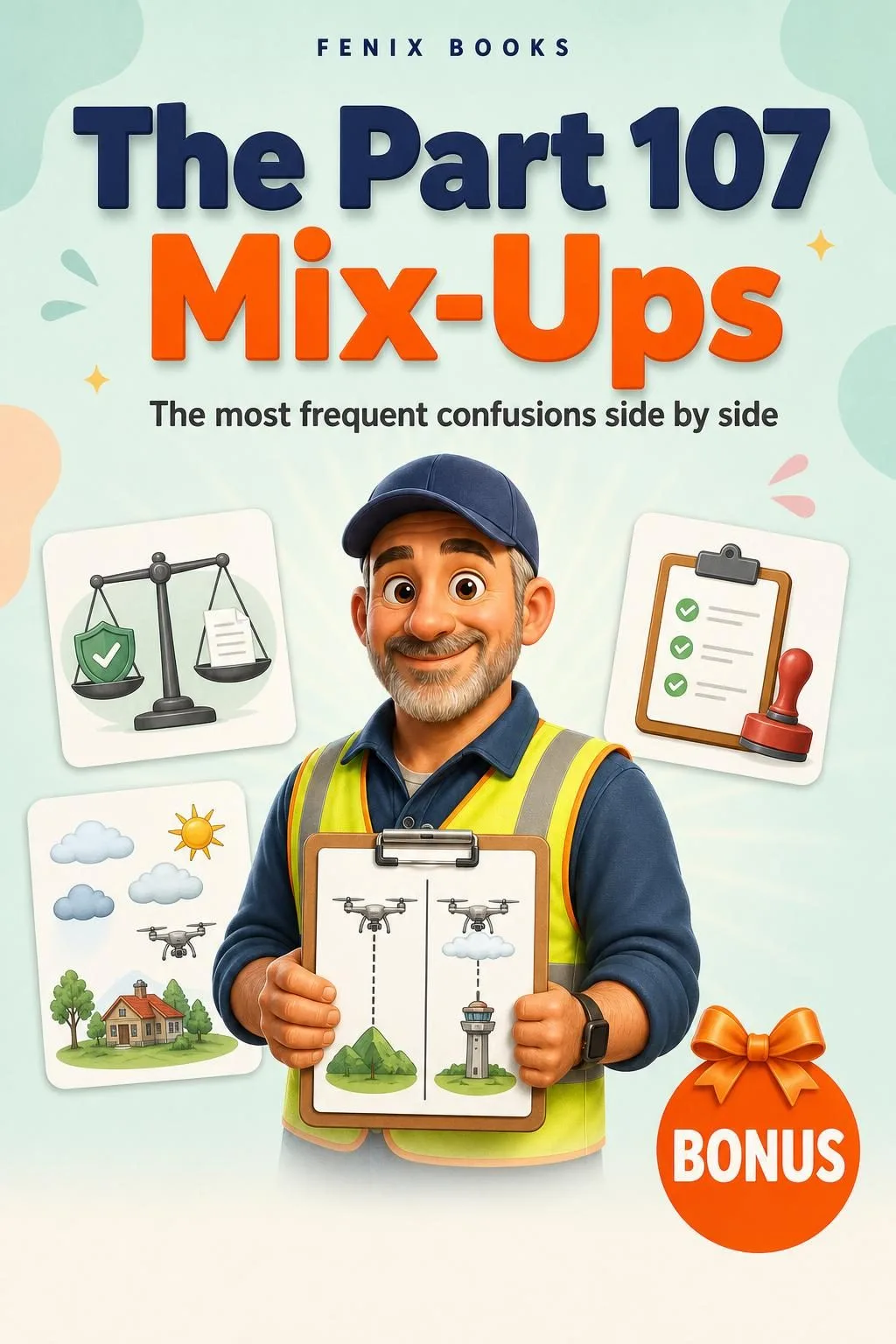
The Part 107 Mix-Ups

BONUS 2: «The Part 107 Mix-Ups»

Value on its own: US$ 14.90

The most frequent confusions side by side, so you stop swapping AGL for MSL or a waiver for an authorization.

Clear to Fly + 2 Free Books

  • Clear to Fly: 63 illustrated pagesUS$ 67.90
  • BONUS 1: Part 107 Chart DrillsUS$ 17.90
  • BONUS 2: The Part 107 Mix-UpsUS$ 14.90
  • High-resolution PDF to printIncluded
Total value US$ 100.70
YOUR PRICE:
US$ 27
You save US$ 73.70
YES, I WANT CLEAR TO FLY FOR US$ 27

📄 This is a digital PDF book sent to your email: nothing is printed or shipped.

Secure purchaseEncrypted payment30-day guarantee

PDF by email: Clear to Fly reaches your inbox as a PDF, and the two free books come by email too. One-time payment, no installments or hidden costs.

Is This Book for You?

You're studying for Part 107

You're studying for Part 107

Charts, METARs and airspace one topic per page, to review in short sessions between jobs. No aviation background needed: every topic starts from the drawing.

You fly recreationally and a client just asked for paid work

You fly recreationally and a client just asked for paid work

Recreational vs. Part 107 on one page, then Remote ID, LAANC and the 400-foot ceiling each with its own drawing. The rules that sound different on every forum are in a fixed order here.

Your 24-month recurrent training is coming up

Your 24-month recurrent training is coming up

All the numbers on one page, the most frequent mix-ups side by side in The Part 107 Mix-Ups, and the same drawn topics to flip through before your review. A printed copy in the flight bag beats a half-remembered list.

To Sum Up: Here Is What You Get

US$ 100.70US$ 27
YES, I WANT CLEAR TO FLY FOR US$ 27

📄 This is a digital PDF book sent to your email: nothing is printed or shipped.

30DAYS
GUARANTEE

30-Day Guarantee

30-day guarantee: tell us what didn't work and we'll refund 100%.

You have 30 days to try Clear to Fly and the two bonus books. If a file won't open, if the content isn't what this page describes, or if something doesn't arrive, email us and we'll refund 100% of what you paid. One-time payment, no subscriptions, no surprises.

Frequently Asked Questions

How do I get it?

Clear to Fly comes as a high-resolution PDF by email, to the address you enter at checkout, to read on your phone or print. The two bonus books, Part 107 Chart Drills and The Part 107 Mix-Ups, also come by email.

Is it a monthly or one-time payment?

One-time payment. No installments and no subscription.

Who is it for?

For anyone preparing for the FAA Part 107 knowledge test, from recreational drone owners crossing over to paid work to roofers, realtors and inspectors who already fly for work. It also works as a recurrent review: if 24 months have gone by, the numbers page and The Part 107 Mix-Ups put everything back in one place. Check the table of contents above to see every topic.

I fly recreationally. Do I need Part 107?

If anyone pays you to fly, or if the flight is for a business, you need Part 107. The book covers recreational vs. Part 107 on one page, plus Remote ID, LAANC and the 400-foot ceiling, each with its own drawing.

I already passed Part 107. Is this useful for my recurrent review?

Yes. All the numbers are on one page, the most frequent mix-ups are side by side in The Part 107 Mix-Ups, and every topic is still one drawn page you can flip through before your 24-month online training. It is also a quick reference for the field.

Can I use it on the job?

Yes. The last section has a Can I Fly Here? checklist: chart, airspace class, floor in AGL, LAANC grid, TFRs, people below and Remote ID, in the same order every job. Print it and keep it in your flight bag.

What sources is it based on?

14 CFR Part 107, the FAA Remote Pilot Study Guide (FAA-G-8082-22), the Remote Pilot Airman Certification Standards (FAA-S-ACS-10), Advisory Circular AC 107-2A and the FAA Airman Knowledge Testing Supplement (FAA-CT-8080-2H). It covers Remote ID and operations over people. Rules change, so the PDF shows its review date and points you to faa.gov.

Is it official FAA material?

No. It is an independent study book. It is not published, approved or endorsed by the FAA, and it is not FAA training or a certificate.

Does it replace a course?

No. It is study material to prepare and review. It does not replace the FAA's materials or a training course, and it cannot guarantee a passing score. Your certificate comes from passing the knowledge test at an FAA-approved testing center.

Are the practice questions the real test questions?

No. The questions in Part 107 Chart Drills were written for this book, built like the test's chart and weather items, with each answer explained. They are not official test questions: they are for practice.

Can I print it?

Yes. It is a PDF you can print at home or at a print shop and keep in your flight bag. The review sheets in The Part 107 Mix-Ups are made to print.

What if I don't like it?

30-day guarantee: if it does not help, tell us what did not work and we refund 100%.

One Last Thing Before You Decide...

You don't have to reread the same page hoping it sticks this time.

You don't have to memorize airspace rules you can't picture.

And you definitely don't have to walk into the test not knowing where to start.

There's a simpler way. And it's one click away. Now it's your turn.

One-time payment: US$ 27 · Guarantee: 30 days · PDF by email

YES, I WANT CLEAR TO FLY FOR US$ 27

📄 This is a digital PDF book sent to your email: nothing is printed or shipped.